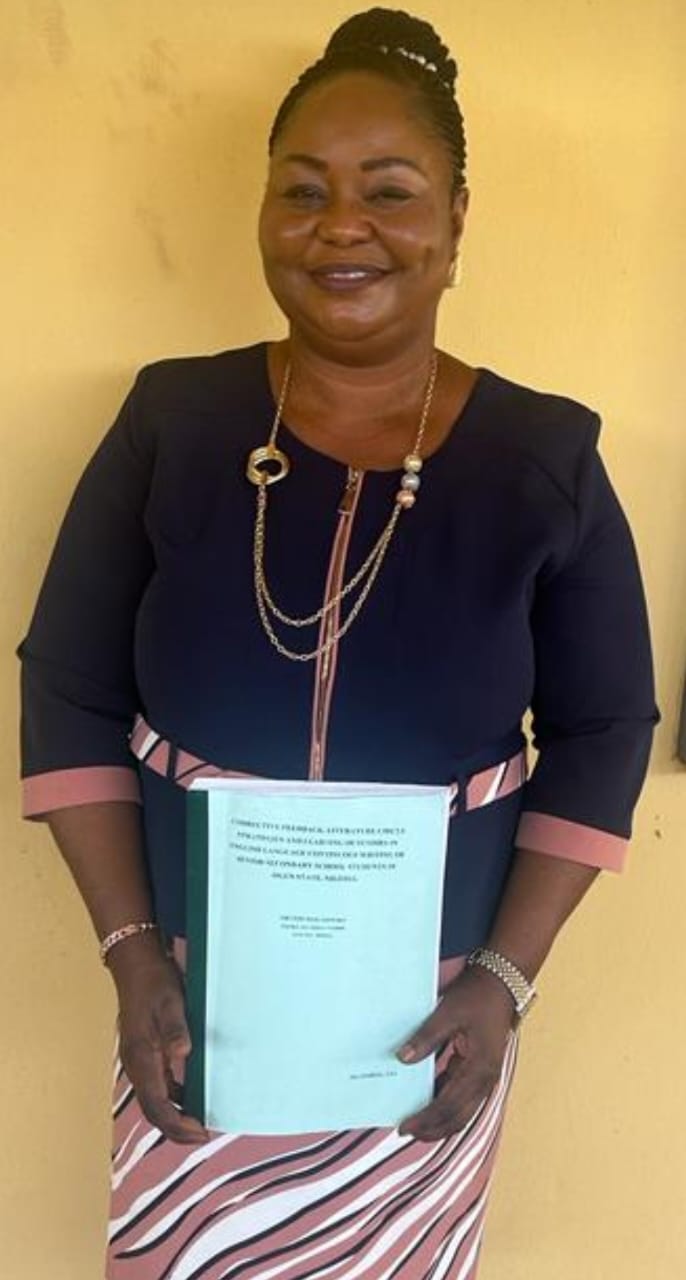
Dr. Stella Adebimpe Okueso
Academic Session
2025
"CORRECTIVE FEEDBACK, LITERATURE CIRCLE STRATEGIES AND LEARNING OUTCOMES IN ENGLISH LANGUAGE CONTINUOUS WRITING OF SENIOR SECONDARY SCHOOL STUDENTS IN OGUN STATE, NIGERIA."
Project Abstract / Student Bio
The poor writing skills of students account for their poor performance in English language as reported in the West African Examination Council and National Examination Council results. The conventional method of teaching English is said to be deficient in abating this poor performance of students hence the search for innovative strategies for teaching and learning English in an attempt to improve learners’ continuous writing skills. Therefore, the study investigated the effect of corrective feedback and literature circle strategies on students’ learning outcomes in English language.
One hundred ten (n= 110) participants were chosen using a multi-stage sampling procedure: the first stage used a stratified random sampling technique where the study used the three senatorial districts of Ogun East, Ogun West, and Ogun Central as the three strata; the second stage used a simple random sampling technique to choose a local government from each of the three districts of the state; and the third stage used a purposive sampling technique. Ijebu Southern Grammar School, Ala-Ijebu to Corrective Feedback, Orile-Ilugun Comprehensive High School, Orile-Ilugun to Literature Circle, and Sango Otta Senior High School to Convention Method were among the three (3) schools that were arbitrarily assigned to receive therapy. The study used an intact class to avoid distraction and disruption of regular school activities.
The data collected for the study were analysed using descriptive and inferential statistics. Descriptive statistics were used to present participants’ demographic characteristics and their distribution by strategy, gender, and parental educational support, employing frequencies, percentages, graphs, means, and standard deviations. Inferential analysis involved ANCOVA to test fourteen hypotheses, while Multiple Classification Analysis (MCA) was used to interpret post-test achievement and attitude scores. The study examined three instructional strategies, two gender groups, and two levels of parental educational support, with Scheffe post-hoc tests applied to significant main effects at the 0.05 level.
The
study indicated that corrective feedback and literature circles are more
effective than conventional methods in improving students’ continuous writing.
Corrective feedback helps learners understand the reasons for their errors and
how to correct them, while literature circles promote student-centred learning
through shared roles, interaction, and diverse texts. Reading aloud also
enhances writing skills. The findings further show that gender and parental
educational support do not significantly influence students’ performance when
these strategies are used, suggesting that they are inclusive and effective for
all learners.
Based
on the findings, it is recommended that secondary school English teachers adopt
corrective feedback and literature circle strategies to improve students’
skills and attitudes in continuous writing. Teachers should be supported with
adequate resources, such as books and access to e-libraries, and encouraged to
attend relevant training and professional development programmes. Schools
should promote the use of diverse literary texts, peer-reading clubs, and
well-equipped libraries to support group reading activities. In addition, the
Teaching Service Commission should organise workshops and seminars to train
teachers on these strategies, and, with university approval, the
recommendations should be forwarded to the Ministry of Education and relevant
agencies for wider implementation.
Project Document
Open in New TabSupervised By
Professor Sefiu Ayanfe Oluwayomi Oladunjoye