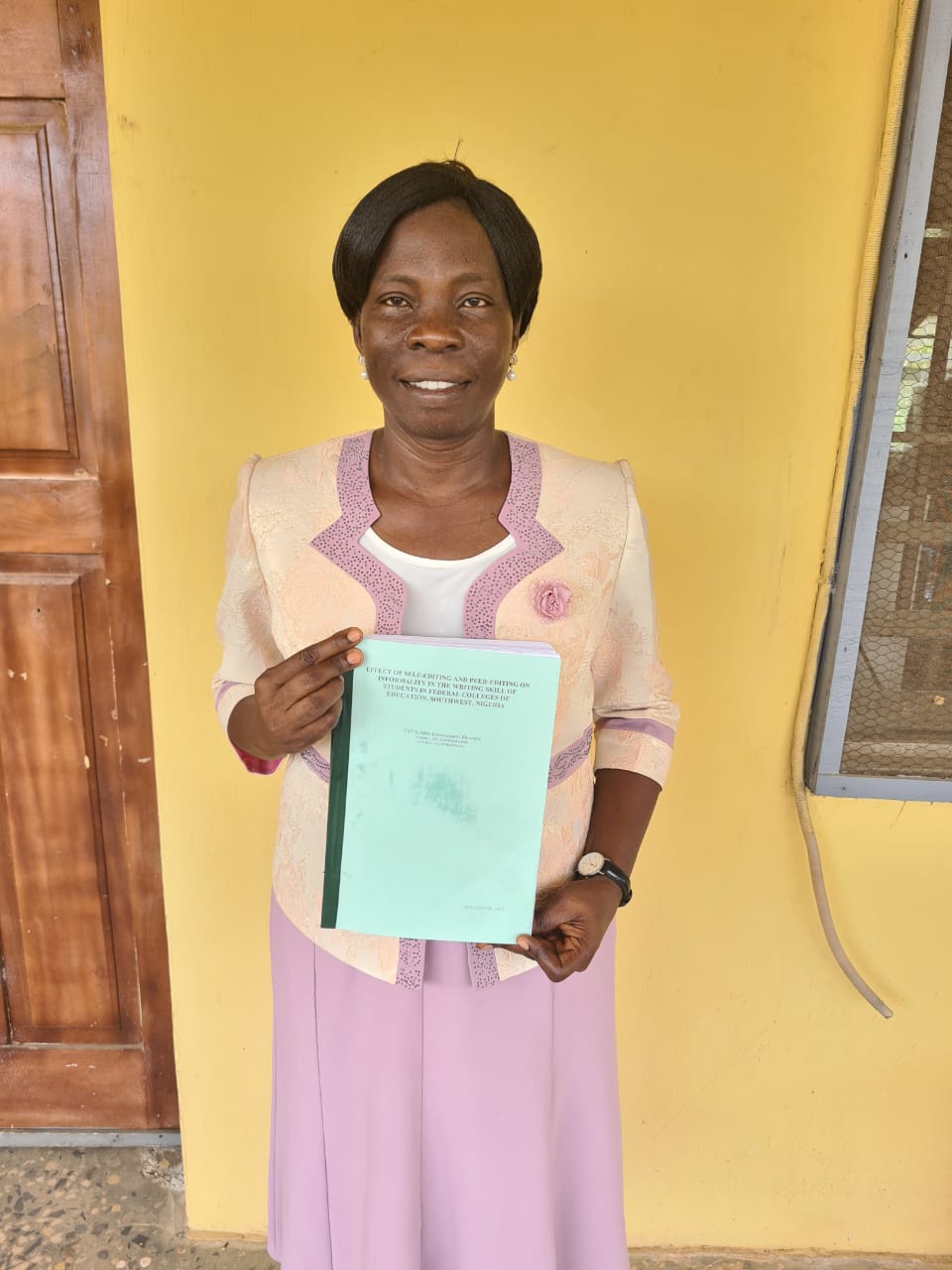
Dr. (Mrs.) Oluwayemisi Florence Fatiloro
Academic Session
2025
"Effect of self-editing and peer-editing on informality in writing skill among college of education students in South-West, Nigeria"
Project Abstract / Student Bio
The
study examined the effect of self-editing and peer-editing on informality in
writing skill among college of education students in South-West, Nigeria. A
pre-test, post-test, control group quasi-experimental research design with a
3x3x2 factorial matrix was adopted for the study. Target population for the
study comprised all of the students of Federal Colleges of Education in
South-West's while sample was four hundred and seventy-six students selected
through multi-stage sampling procedure. Writing Achievement Test 1- Composition
Test, Writing Achievement Test 2-Multiple Choice Questions, Writing
Self-Efficacy Questionnaires, Self-Editing Checklist of Informality and
Peer-Editing Checklist of Informality were employed for data collection in the
study. Analysis of data was done with Analysis of Covariance and Sidak Pairwise
Test.
Findings
from the study revealed a significant outcome of the main effect of treatment
(editing strategies) having the highest post-test knowledge mean score of
informality in writing skill. The result also indicated a significant main
effect of writing self-efficacy on the students’ knowledge of informality in
writing skill mean scores. While gender showed no significant main effect of
gender on the students’ knowledge of informality in writing skill scores,
editing techniques and writing self-efficacy had a significant interaction
effect on the students' informality in writing ability ratings, as shown by the
results of the 2-way interaction effect. Additionally, the results revealed a
statistically significant interaction effect of editing techniques, writing
efficacy and gender on the students' informality in writing skill scores.
The
study concluded that self-editing and peer editing strategies applied to teach
informality in writing skill in this study were potent. Taking learners through
them will improve their writing accuracy. This study thus recommended that
teachers (at all levels) should employ both peer-editing and self-editing in
writing classrooms; schools should include practical sessions and concurrent
feedback in language courses in order to empower students’ participation in
writing; and Standard British English, which is the variety in which Nigerians
are weaned on and is employed for students’ assessment, should be taught and
enforced right from primary to post primary institutions.
Project Document
Open in New TabSupervised By
Professor Sefiu Ayanfe Oluwayomi Oladunjoye